
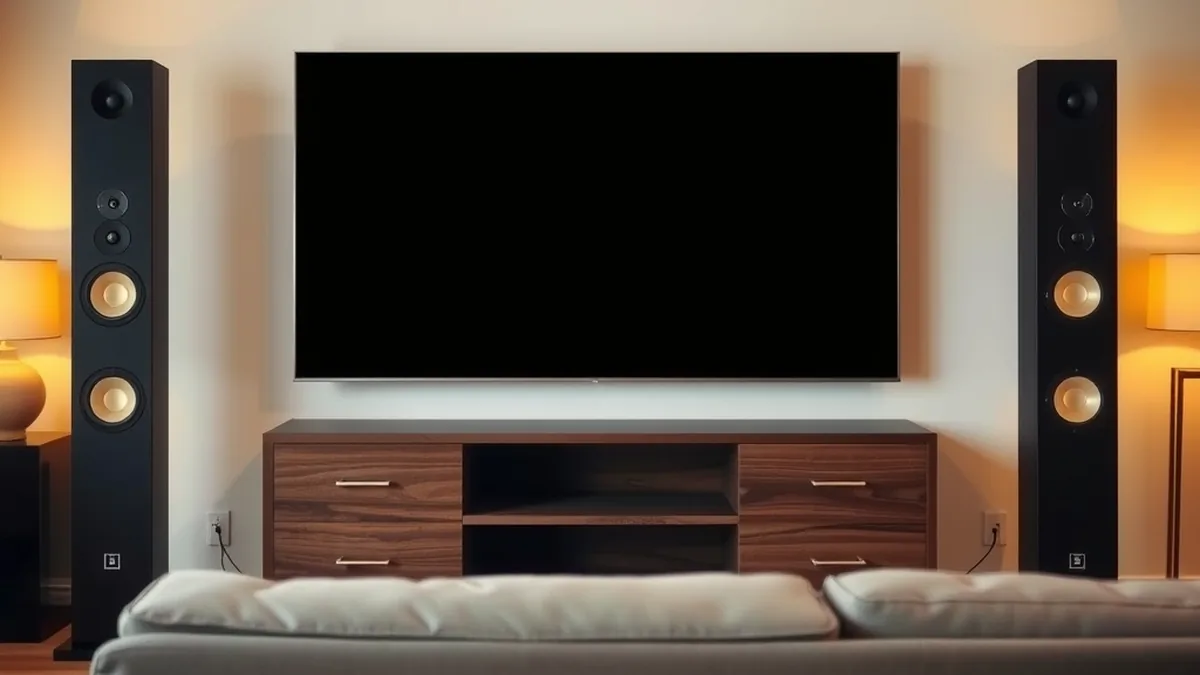
Short answer: pick the speakers that suit the room you have, not the ones that measure best in a review. Start with a good center channel, add a subwoofer before you add more speakers, and keep the whole set from one product line.
Most home theater advice is written for a rectangular basement room with nothing in it. Almost nobody around here has that. What you have is a great room with a vaulted ceiling, a couch that can only go in one place, and a TV mounted over the fireplace. Here’s how to choose for that.
How many speakers do you actually need?
The numbers you see — 5.1, 5.1.2, 7.1.4 — are just a count. The first number is speakers at ear level. The .1 is the low-frequency channel that feeds your subwoofer; it stays “.1” whether you run one sub or two. The last number is height channels for Dolby Atmos.
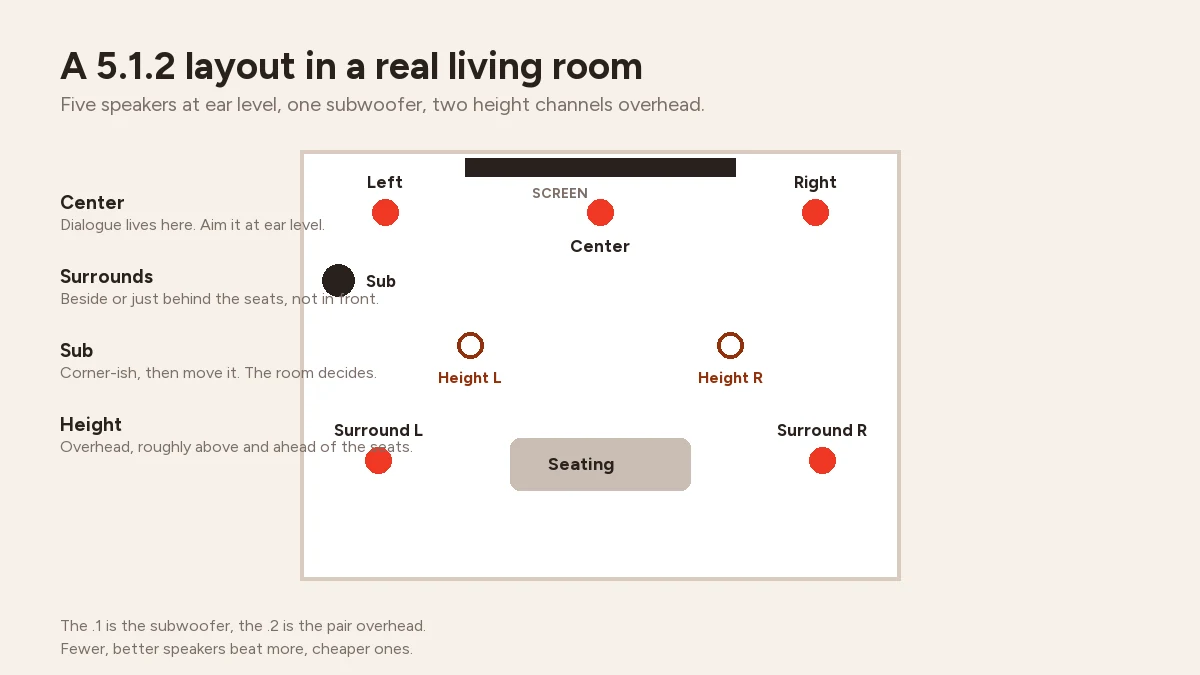
5.1 is the honest baseline for a living room: left, center, right, two surrounds, and a subwoofer. It’s what almost everything still gets folded down to, and done well, it’s genuinely convincing.
7.1 adds two more surrounds behind you. Worth it in a long room where the couch sits well forward of the back wall. Where the couch is against the wall, it does very little — the extra speakers end up a foot from your head.
Atmos height channels are the .2 or the .4. Rain, helicopters, a plane going over. Real, and more useful than people expect — but check your ceiling before you commit, below.
The rule that saves the most money: fewer, better speakers beat more, cheaper ones. A well-chosen 5.1 will embarrass a bargain 7.1.4 almost every time, and you can always add the height channels next year.
The center channel is the one that matters
In a 5.1 or 7.1 mix, essentially all the dialogue is assigned to one speaker: the center. So is most of the on-screen action that has to track with the picture. If people in your house say “I can’t hear what they’re saying” and reach for the remote, the center channel is almost always why.
So if the budget has to bend somewhere, don’t bend it here. Two good front speakers and a cheap center is the most common mistake we see, and it’s backwards. Buy the center from the same line as the left and right, and aim it at ear level.
That last part is where most living rooms have a problem.
Where the speakers actually go
Dolby publishes the geometry, and it’s worth knowing before you buy anything, because a speaker that can’t go where it needs to go is the wrong speaker.
- Ear level is 3.9 feet. Dolby puts all listener-level speakers at the same height, typically 3.9 ft (1.2 m) — where your ears are when you’re sitting down.
- Front left and right, about 30° off center. Measured from where you sit, with the center speaker straight ahead as zero.
- Surrounds beside you or just behind you, at ear level, not in front of the seats.
- Overhead speakers at about 45° of elevation from the listening position — Dolby allows 30° to 55° — and roughly 30° to each side.
- Aim everything at one seat. Pick the main listening position and point the speakers at it. There’s no layout that’s optimal everywhere.
None of this needs a laser. A tape measure and a phone compass get you close enough, and close enough is most of the benefit.
TV over the fireplace: how to fix the sound
We sell fireplaces and we sell speakers, so we get this question constantly. Builders around here put the TV over the fireplace because it’s the obvious place for it, and acoustically it’s the worst place in the room.
When the screen is high, the sound wants to stay low. That’s the whole problem in one sentence.
Two things go wrong. The center channel ends up well above ear level, so voices come from over your head rather than from the actors’ mouths — your brain notices, even when you can’t say why. And a mantel is a hard flat shelf directly under the speaker, reflecting sound back at you a millisecond or two later, which blurs the edges of words.
Before you spend anything, a ten-second test: throw a folded blanket along the mantel and watch ten minutes of dialogue. If it gets clearer, the mantel reflection is real in your room and worth fixing. If nothing changes, it isn’t — save the money and deal with the height instead.
Four ways out, best first:
- Get the center channel below the screen. A hearth ledge or a console puts it closer to ear level, and below ear level is a smaller problem than above it. Cheapest fix on this list.
- Angle the center down at the seats. Many centers will sit on a small wedge or an adjustable bracket. Aiming the tweeter at the seats instead of over them gets back most of what the height costs you, for the price of a bracket.
- Lower the TV. Unpopular, and it fixes everything. A pull-down mount buys you the foot that matters — it’s the priciest of the four, and worth pricing before you dismiss it.
- Three identical speakers across the front. In-wall or on-wall left, center, and right at the same height gives the cleanest result, which is why custom installers reach for architectural speakers in rooms like this. It also means opening walls and hiring someone, so it belongs in a remodel rather than a weekend.
What doesn’t work: a soundbar mounted under the TV, halfway up the chimney chase, playing at chest height to nobody. We see it in house after house, and it’s why so many people think their room “just sounds bad.”
One more thing worth knowing, since we sell both. Heat rises, and electronics don’t like it. Most TVs are rated for an ambient temperature somewhere around 100 °F, and your fireplace manufacturer publishes a clearance-to-combustibles figure and a mantel spec — those two numbers together answer the question for your specific unit. It varies a lot between an open masonry fireplace and a modern direct-vent insert, and the difference between those is most of what we wrote about here.
Do I need a subwoofer?
Yes. This is the one place we’ll be blunt.
Floorstanding speakers make bass, but they don’t make the bottom octave — roughly 20 to 40 Hz, the part you feel in your chest rather than hear. A subwoofer also takes that work away from your other speakers, which makes everything else cleaner at volume. It’s the single biggest improvement per dollar in most systems, and it’s the component people skip.
Placement matters more than the model, because bass builds up and cancels out in patterns set by the room’s dimensions. Here’s the trick, and it costs nothing:
- Put the subwoofer up on the couch, roughly where your head goes.
- Play something with steady, repetitive bass.
- Crawl slowly around the floor near the walls and corners, ear about a foot off the ground.
- Wherever the bass sounds fullest and most even is where the subwoofer goes.
It feels ridiculous. It works, and it beats guessing by a wide margin.
One more: two smaller subwoofers usually beat one large one in an open-plan room — not for more bass, but for more even bass from seat to seat. That isn’t folklore; it comes out of published research on multiple subwoofers in rooms, and it’s the reason serious rooms run two.
The free fix most people skip
Before you buy anything else, spend ten minutes in the receiver’s settings. Set every speaker to “Small” rather than “Large,” set the crossover to 80 Hz — the usual default, and the right starting point for most speakers — and run the auto-calibration with the microphone that came in the box, at the seat you actually use.
That sends the deep bass to the subwoofer, which is built for it, and relieves your other speakers of work they do badly. It’s free, it takes ten minutes, and it improves dialogue more than most upgrades do. Dolby makes the same point about Atmos modules specifically: they aren’t full-range speakers, so bass management has to be set correctly for them.
Is Dolby Atmos worth it in a normal room?
Often, yes — but it depends entirely on your ceiling.
Height channels work by putting sound above you. In-ceiling speakers do that directly. Up-firing modules — speakers that sit on top of your floorstanders and bounce sound off the ceiling — need what Dolby asks for: a ceiling that’s flat, not angled or vaulted, between 7.5 and 14 feet up (ideally 7.5 to 12), and made of something acoustically reflective. Drywall, plaster, and hardwood all qualify.
A cathedral ceiling is the problem case. The reflection still happens; it just goes somewhere other than your couch, and the higher the peak, the less comes back. A gentle slope or a tray ceiling is usually fine. A twenty-foot peak is not. If that’s your room, either go in-ceiling or put the money into a better 5.1 and enjoy it.
What do you drive them with?
Everyone reads watts. The number that decides how much amplifier you need is sensitivity — how loud a speaker plays on a given amount of power.
The arithmetic is simple and worth carrying around: every 3 dB of sensitivity is worth a doubling of amplifier power. So a speaker 6 dB more sensitive than another reaches the same volume on a quarter of the amplifier. That is a much bigger lever than the difference between two receivers.
This is the practical case for horn-loaded speakers — the driver fires through a shaped horn, which is what makes them efficient — and it’s what Klipsch has built since 1946. A mid-priced receiver drives them to convincing levels without strain, and the savings go into the speakers. Low-sensitivity speakers can sound terrific, and they need a lot more amplifier to do it: a real cost, not a footnote.
Sensitivity isn’t the whole story, though. A small speaker runs out of headroom eventually no matter what you feed it, so match the size of the speaker to the size of the room as well.
If you’re considering separates rather than a receiver, that’s a different conversation — Emotiva is one of the brands we’ll walk you through when it’s warranted. It’s a step most people don’t need on day one and some never need at all. We’ll say so.
Klipsch Reference vs Reference Premiere: which one?
The most common question we get, and the answer is simpler than it looks online.
Klipsch’s own materials, as they stand today: the Reference line pairs an aluminum LTS tweeter with spun-copper TCP — thermoformed crystalline polymer — woofers, a material Klipsch says it brought down from the Reference Premiere series. Reference Premiere uses a titanium LTS tweeter and cerametallic woofers, which are stiffer and better damped, giving higher output and a more solid bass foundation. Both are horn-loaded and both share the family character. Premiere is the step up in materials, build, and headroom.
In practice: Reference for most living rooms, Reference Premiere for a dedicated room, a large open space, or anyone who plays things loud.
One instruction straight from Klipsch, worth following: keep the line consistent across the whole system. Mixing a Premiere center with Reference surrounds tends to expose the cheaper speakers instead of lifting the whole system. Pick a line and stay in it.
Checked against Klipsch’s published product specifications, September 2026. Klipsch refreshes both lines every few years and changes materials when it does, so treat any spec you read online as a snapshot — ask us what’s actually in the box.
Buying it in stages
Most people don’t buy a system in one go, and you don’t have to. The order that wastes the least money:
- Left, center, and right, from one line. This is the system. Everything else is addition.
- The subwoofer. Biggest single jump you’ll hear.
- Surrounds. Now you have 5.1, and you’re done in any meaningful sense.
- Height channels. If the ceiling suits them.
- Better electronics. Last, and only if you have a reason.
One honest note about price
Klipsch sets minimum advertised pricing, so authorized dealers start from the same footing. Promotions, outlet stock, and refurbished units still come and go — we’ll tell you when one of those is genuinely the better buy, and when it’s last year’s model with a new sticker.
What you get from a dealer instead of a shopping cart is someone who asks about the room before the budget, tells you when the cheaper model is the right one, and answers the phone after the box is open. If that’s worth nothing to you, buy it anywhere. If it’s worth something, that’s the whole pitch.
Who installs it?
Not us — we sell and advise, and we don’t install. For wiring, mounting, in-wall work, and calibration we refer you to installers we trust, and we coordinate with them on the equipment. Plenty of customers set the system up themselves, and we make sure everything they buy works together before it ships.
If you’re building or remodeling, talk to us early. Pre-wiring is trivial before drywall and miserable after, and the ceiling decision above is much cheaper to make now. More on how this goes on our process page and the home theater and audio page.
A few more questions we get
How many speakers do I need for a home theater?
Five plus a subwoofer is the honest baseline for a living room, and it’s what most content gets folded down to. Add height channels for Atmos if your ceiling suits them, and rear surrounds only if the couch sits well away from the back wall.
Where should the center channel go if the TV is above the fireplace?
As low as you can get it, and angled down at the seats. Below the screen on a hearth ledge beats above the fireplace, and a tilting bracket or wedge recovers most of the rest. Three matching on-wall or in-wall speakers across the front is the cleanest fix, though it means opening walls.
Can I mix Klipsch Reference and Reference Premiere speakers?
You can, but Klipsch recommends against it and so do we. Keeping one line across the system keeps the tonal character consistent; mixing tends to make the cheaper speakers stand out.
Do I really need a subwoofer if I have floorstanding speakers?
Yes. Floorstanders make bass, not the bottom octave — roughly 20 to 40 Hz — and a subwoofer also relieves them of work they do poorly. It’s the biggest improvement per dollar in most systems.
Can I listen before I buy?
We don’t have a showroom, but we keep a private listening setup and can arrange a session by appointment for a serious purchase. If you’d rather hear a system somewhere else first, tell us and we’ll say where to go — we’d rather you hear it than guess.
Send us the room, not the shopping list.
A photo of the wall, rough dimensions, the ceiling type, and where the couch has to go. We’ll come back with two or three ways to do it at different levels, tell you which one we’d pick, and say plainly what you don’t need.
Request a quote · Serving Montgomery County, Maryland · By appointment, Mon–Fri 9–6 and weekends
