
Short answer: yes. A gas fireplace needs a WSSC Water permit and inspection. A wood-burning insert or stove needs a Montgomery County DPS mechanical permit. A plug-in electric fireplace usually needs neither.
The part that trips people up is that a gas fireplace and a wood-burning insert go to two different agencies — and for gas, you’re not allowed to do the work yourself.
Budget somewhere around $110 in county fees for a wood insert, and about a week of calendar time either way. Everything below is from the agencies’ own published pages, linked as we go, and checked in September 2026.
Why gas fireplace permits go to WSSC Water, not the county
This is the single most confusing thing about installing a fireplace here, so it’s worth being plain about it.
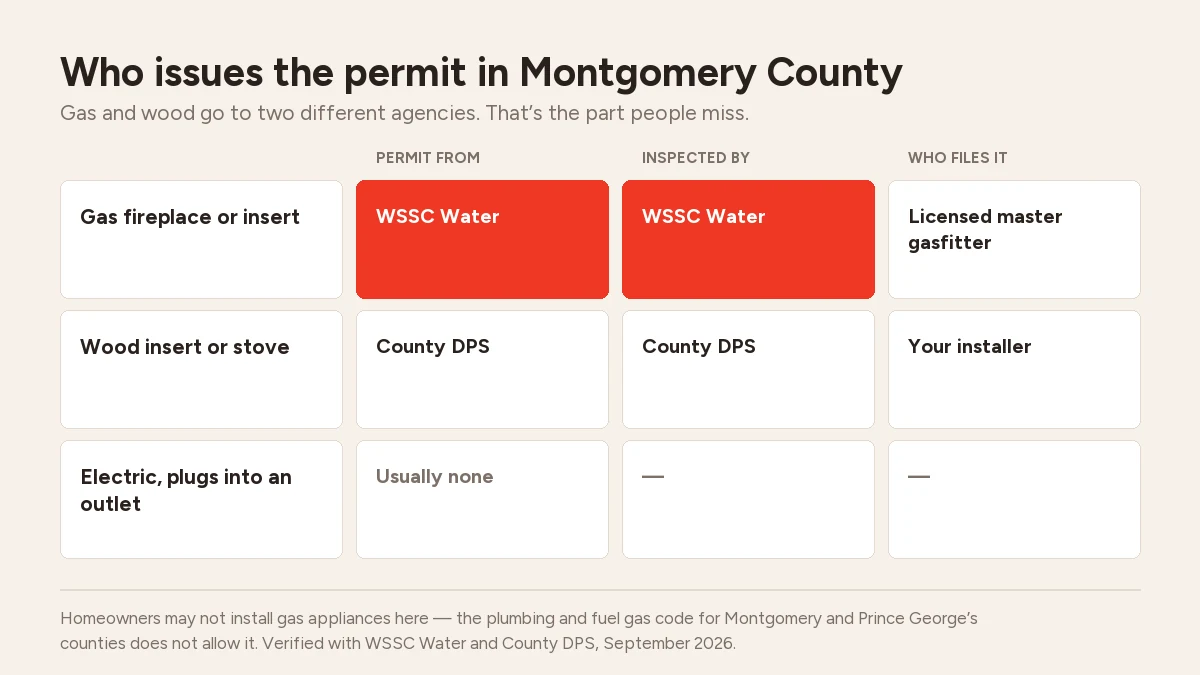
The State of Maryland has charged WSSC Water with permitting and inspecting all natural gas and liquefied petroleum (LP) gas installations in Montgomery and Prince George’s Counties. Not the county. Not the fire department. The water utility. It’s a historical arrangement, it surprises almost everyone, and it’s why calling DPS about your gas fireplace gets you transferred.
Three things follow from it, and each one has cost somebody a weekend:
- Every gas appliance needs its own permit. WSSC requires a permit and an inspection for every first-time installation and every replacement. Swapping an old gas insert for a new one counts. One permit per appliance.
- You may not do it yourself. The Plumbing and Fuel Gas Code for Montgomery and Prince George’s Counties does not allow homeowners to install gas appliances. This isn’t a recommendation. You hire a WSSC Water–licensed plumber or gasfitter, and they pull the permit and schedule the inspection.
- Propane counts too. “Gas” here means LP as well as natural gas. If you’re on a propane tank up in Upcounty, you’re in the same process as everyone on the gas main.
How the gas inspection actually runs
Your gasfitter pulls the permit before starting. After the appliance is in, the inspection has to happen within ten business days of the installation, and it’s the licensee’s job to book it — they can schedule up to three business days ahead, and WSSC inspects Monday through Friday, 7:30 a.m. to 2:30 p.m.
When it passes, the inspector leaves a green APPROVED sticker on the appliance. Photograph it. You’ll want that picture when you sell the house.
Do I need a permit for a wood stove or insert in Maryland?
Yes — and it goes to the county, not to WSSC. Wood-burning appliances are heating equipment, and heating equipment goes through the Department of Permitting Services on a residential mechanical permit — the same permit used for a furnace or a boiler. It covers installing, replacing, altering or removing the equipment, and you apply online.
DPS doesn’t publish a fireplace-specific permit page, so here’s the reasoning in the open: a mechanical permit covers installing and replacing heating equipment under the IMC, IFGC and IRC, and the county’s mechanical fee schedule carries line items for pre-fabricated fireplaces and pre-fabricated chimneys. That puts hearth appliances on the mechanical permit. What it doesn’t settle is a wood insert dropped into an existing masonry fireplace — there’s no line item named for that. Have your installer confirm the permit type with DPS before you order. It takes one call: 311 inside the county, or 240-777-0311.
Chimney work usually rides along with the appliance permit rather than standing alone, but confirm that too — a chimney that needs structural repair is a different conversation from a stainless liner dropped down an existing flue. Our fireplaces page covers what goes into each kind of unit.
Does an electric fireplace need a permit?
Not if it plugs in. A plug-in electric fireplace is an appliance, not an installation. You take it out of the box and plug it in. No permit, no inspection, no agency.
The exception is a hardwired unit, particularly a 240-volt one. That’s a new circuit, which means electrical work, an electrician, and an electrical permit. If a product spec sheet says “hardwired,” assume you’re in permit territory and ask.
What does a fireplace permit cost in Montgomery County?
The county publishes its numbers. For the schedule running July 1, 2026 through June 30, 2027, a residential mechanical permit on a one- or two-family home starts at a $80.84 minimum fee, and equipment is charged on top:
| Line item | Fee |
|---|---|
| Minimum mechanical permit fee, one- and two-family | $80.84 |
| Heating equipment | $28.61 per 100 MBH or fraction |
| Pre-fabricated fireplace | $32.34 |
| Pre-fabricated chimney | $17.41 |
On the published lines, a wood-burning insert works out to about $110 — the $80.84 minimum plus one $28.61 heating-equipment charge, since hearth appliances run well under 100 MBH. Whether DPS also applies the $32.34 pre-fabricated fireplace line depends on the unit. The schedule is an estimate; DPS calculates the final fee when the permit is issued.
WSSC prices its permits on its own schedule rather than the county’s, and there’s no line on it that says “gas fireplace.” Ask your gasfitter to show the permit as a separate line on the quote rather than folding it into a lump sum, and call WSSC Permit Services at 301-206-4003 if you want the current number yourself — Monday to Friday 7 a.m. to 4 p.m., except Wednesdays, when they close at noon.
Either way, this is not the expensive part. It’s a rounding error next to the equipment and the venting — which is exactly why skipping it makes no sense.
How long does it take?
Less time than people fear, but not zero, and it’s the part that decides whether the fireplace is working by Thanksgiving.
On the county side, a straight one-for-one replacement can be issued immediately; anything needing plan review typically takes about three business days. On the gas side, the permit is pulled before work starts and the inspection follows within ten business days of installation, booked up to three days ahead.
So the honest planning number is roughly a week on either side of the install day, assuming nothing unusual. What actually sets your calendar is equipment lead time and the installer’s schedule — in the fall, both stretch. If you want a fire this winter, the permit is not what will hold you up.
What happens if you skip it?
People do skip it, usually because somebody offered to do the job cheaply and quietly. Four things go wrong, cheapest to worst.
You lose your warranties. WSSC is explicit that failing to get the inspection done on time can affect the manufacturer’s warranty and the installer’s own one-year warranty — which runs from the date the final inspection is approved. No approved inspection, no clock, no cover.
Your insurance company may want to know. Adding a wood-burning or gas appliance can change what your policy covers, and carriers differ on what they ask for. Call your agent before the work, not after a claim.
It shows up when you sell. An unpermitted heating appliance is exactly the kind of thing a buyer’s inspector flags and a buyer’s agent uses. An after-the-fact permit is usually possible, and it’s not the cheap path — you may be opening up work that’s already closed in to show an inspector.
And the reason the rule exists. Gas appliances installed badly produce carbon monoxide; wood appliances installed with the wrong clearances or an unlined flue start house fires. The inspection is a second set of eyes on the one appliance in your home that’s deliberately on fire.
Buying a house with a fireplace already in it?
Worth ten minutes before closing.
For a gas appliance, look for the green APPROVED sticker, and if there isn’t one, WSSC can check its records — 301-206-4004. For wood, county permit records are public and searchable through the DPS permitting portal. If nothing turns up, that isn’t a deal-breaker; it’s a negotiating point and a reason to have the chimney and the appliance inspected properly before you light anything.
For a house that has sat empty, or one where the fireplace hasn’t been used in years, get the chimney swept and inspected regardless of what the paperwork says.
Building new? There’s a separate wrinkle.
Montgomery County’s Bill 13-22 directs all-electric standards for new construction by the end of 2026, and gas fireplaces are exempt from it by name. A homebuilders’ challenge lost in federal district court in March 2026 and is on appeal, so check where it stands before you plan around it. There’s also a catch about whether a gas line will actually reach the house, and we went through both in gas vs wood vs electric.
What about fire pits and outdoor burning?
Different rules, and people mix them up constantly. Open burning without a permit is prohibited in Montgomery County, with fines that run to $500 a day — but “open burning” means material burned on the ground or in an open container, not an enclosed appliance vented through a chimney. Your insert is not open burning.
Fire pits are their own thing. DPS publishes outdoor fire pit guidance for single-family homes: at least 10 feet from the house, at least three feet of clear radius around the appliance, at least three feet from mulch, not on a deck or balcony, and not on Code Orange or Code Red air quality days. Read it before you design a patio around a fire feature, and call DPS Fire Code Compliance at 311 or 240-777-0311 with anything it doesn’t answer.
Who handles all this for you?
Your installer does — and to be clear about our part in it: we sell and advise, and we don’t install. Jesse isn’t a licensed contractor, and for gas the code wouldn’t allow it anyway.
What we do is line up an installer we’ve worked with, lock in their price before you order anything, and stay in the loop while they handle delivery, the permit and handoff. Their contract is with you, and we don’t take a cut. That’s the whole arrangement, and it’s on our process page in more detail.
When you’re comparing installers, two questions separate the professionals from the rest: which agency are you pulling the permit from, and what’s your license number? Anyone who does this for a living answers both without pausing.
A few more questions we get
Do I need a permit to replace an existing gas fireplace?
Yes. WSSC requires a permit and inspection for replacements, not just first-time installations. A like-for-like swap still counts.
Can I install a gas fireplace myself in Montgomery County?
No. The Plumbing and Fuel Gas Code for Montgomery and Prince George’s Counties does not allow homeowners to install gas appliances. A WSSC Water–licensed plumber or gasfitter has to do the work and pull the permit.
Do I need a permit for a wood-burning insert if the fireplace is already there?
Yes, a permit is required. DPS handles it on a residential mechanical permit, which covers installing and replacing heating equipment. The county doesn’t publish a fireplace-specific permit type, so have your installer confirm the exact permit with DPS before ordering.
Who do I call to check the rules for my job?
DPS is at 311 inside the county or 240-777-0311, and their office is at 2425 Reedie Drive in Wheaton, Monday to Friday 7:30 a.m. to 4 p.m. WSSC Permit Services is at 301-206-4003, Monday to Friday 7 a.m. to 4 p.m., except Wednesdays until noon. Requirements change, and those two are the authority — this page isn’t.
Does an electric fireplace need a permit?
Not if it plugs into a standard outlet. A hardwired or 240-volt unit means electrical work and an electrical permit.
Want the permit question answered for your actual house?
Tell us what you’re thinking of putting in and whether you’re on natural gas, propane, or neither. We’ll tell you which agency it goes to, roughly what the fees run, and what it adds to the timeline — then line up an installer who does this every week.
Request a quote · Serving Montgomery County, Maryland · By appointment, Mon–Fri 9–6 and weekends
