
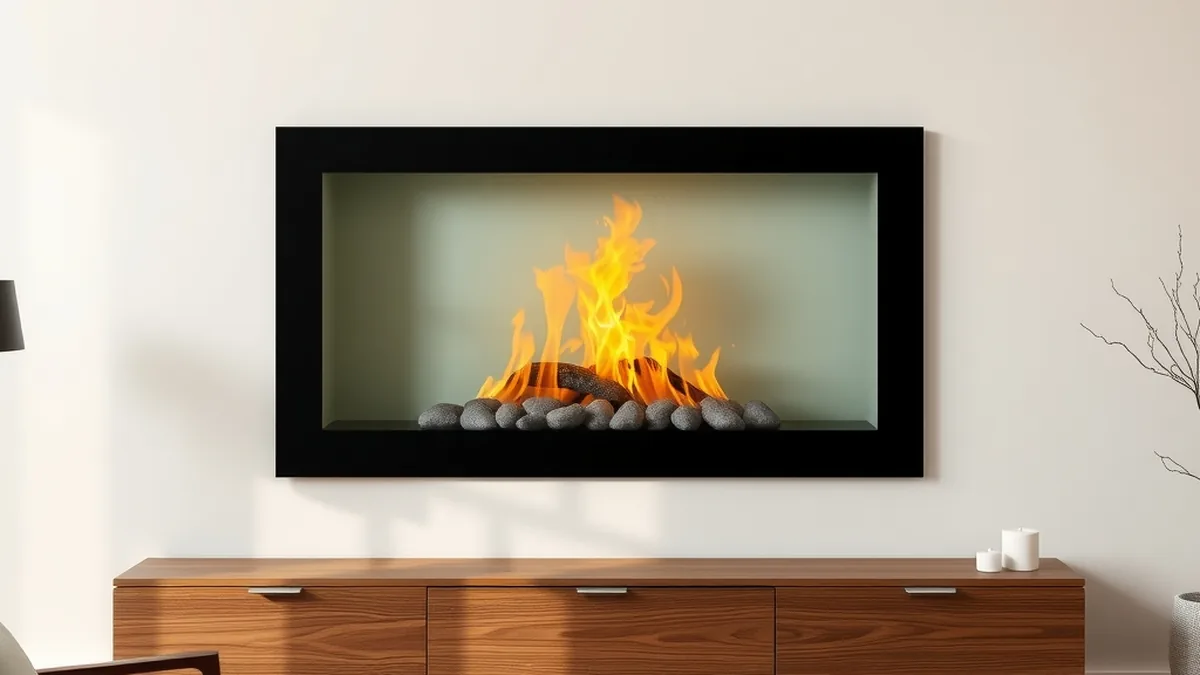
Three technologies, three completely different answers, and almost every guide online is written for the whole country at once. Here’s how the choice actually plays out in Montgomery County — including the fuel math, which is where most people get surprised.
The short version: start by finding out whether you’re on natural gas or propane. If there’s a tank in the yard, everything below changes. On natural gas, a gas fireplace gives you heat on demand with the least fuss, and it’s the right answer for most homes here. On propane it costs two and a half times as much to run, and wood starts to win. Wood gives you the most heat for the money and keeps working when the power doesn’t, if you’re willing to handle firewood. Electric costs the least to install and the most to run, and it can’t heat a large room — it’s a look, with some warmth attached.
| Gas | Wood | Electric | |
|---|---|---|---|
| Typical rating | 15,000–40,000 BTU/h input (roughly 11,000–30,000 delivered) | 30,000–80,000 BTU/h | Up to 5,100 BTU/h on a standard outlet |
| What it needs in the house | Gas line and venting | Chimney or flue, plus a liner | An outlet |
| Permit in Montgomery County | Yes — WSSC for the gas work | Yes — DPS | Usually not, if it plugs in |
| Works in a power outage | Usually, with a standing pilot or battery backup | Yes | No |
| Effort per fire | A switch or a remote | Wood, kindling, ash, an annual sweep | A switch |
| Cost per million BTU of heat | About $21 on natural gas, about $54 on propane | About $20 at $300 a cord | About $64 |
Start with one question: do you want heat, or do you want fire?
Almost every fireplace conversation we have sorts itself out once this is settled, and most people haven’t asked themselves yet.
If you want heat — a room that’s genuinely warmer, a furnace that runs less, something that still works in an ice storm — you’re choosing between gas and wood, and the rest of this article matters.
If you want fire — the light, the focal point, the reason the living room has a center — then electric deserves a serious look, and so does a gas fireplace run on low. You’ll spend a fraction of the money and skip the venting entirely.
There’s no wrong answer. There is a wrong answer for your house, and it usually comes from picking the technology before the goal.
Gas: the default for a reason
A modern direct-vent gas fireplace is a sealed box with a glass front. It takes combustion air from outside through one pipe and sends exhaust back out through another, usually straight through an exterior wall. Nothing is drawn out of your room, and no chimney is required — which is why gas can go in places a fireplace never could before.
Manufacturers rate these units by input: 15,000 to 40,000 BTU per hour is the usual range, and at typical efficiency that’s roughly 11,000 to 30,000 BTU actually delivered into the room. That’s enough to make a living room noticeably warmer and, in a well-laid-out house, to take the edge off the whole floor. Turn it on with a switch, a remote, or a wall thermostat; there’s no ash, no kindling, and no annual sweep.
What it needs from your house: a gas line to the location, and a place to vent. Direct-vent models can terminate on almost any exterior wall, which gives you real freedom in placing one. If you’re already on natural gas, this is usually the straightforward choice.
Here’s the honest part: the flame. A gas fire is very good now — far better than the blue-flame log sets people remember from the nineties — but it isn’t a wood fire, and it never will be. If that matters to you, it matters, and no amount of ceramic logs fixes it.
Wood: the most heat, and the most involvement
A wood-burning insert or stove puts out more heat than anything else here — 30,000 to 80,000 BTU per hour — and it does it without electricity. When a Maryland ice storm takes the power out for three days, wood is the only one of the three that keeps the living room warm.
In exchange, you handle the wood. You stack it, carry it, load it, and clean out ash. You have the chimney swept and inspected once a year. You learn which of your neighbors sells seasoned oak and which one sells green oak and calls it seasoned.
If you already have a masonry fireplace that heats nothing, converting it to a wood-burning insert is the most heat you can add for the money. We wrote that one up separately, line by line: what a wood-burning insert costs to convert.
Electric: the ceiling nobody mentions
Electric fireplaces have gotten much better looking. They install anywhere, need no venting or gas, and usually need no permit. For a condo, a bedroom, a finished basement, or an office, they solve a real problem.
Here’s the part the product page skips. A fireplace that plugs into a standard 120-volt outlet draws at most 1,500 watts. That’s 5,100 BTU per hour — roughly a fifth of what a mid-size gas fireplace delivers, and about a fifteenth of a large wood insert. It will warm a small room. It will not heat a great room with a two-story ceiling. When a product description says “supplemental heat,” that’s exactly what it means.
Hardwired 240-volt models go higher, but at that point you’re running a new circuit and you’re back to permits and an electrician.
Judge an electric fireplace on how it looks and how easily it goes in. Those are its real strengths. Buying one as a heater is how people end up disappointed.
What does it actually cost to run?
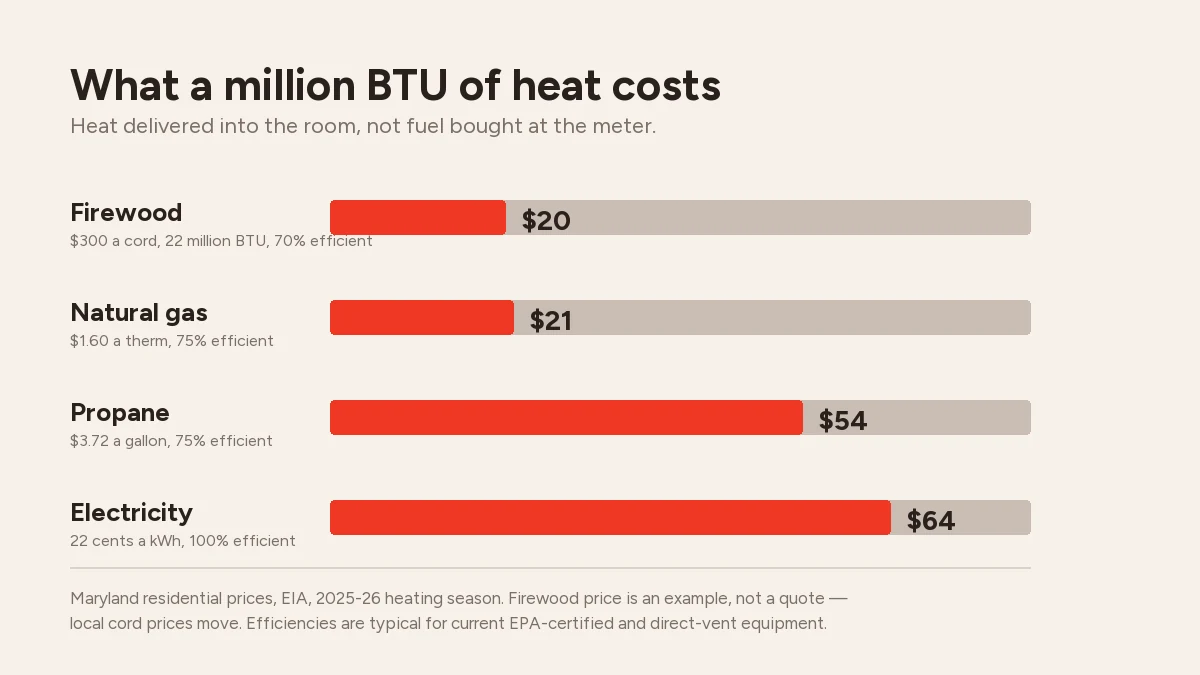
Comparing fuels by the unit they’re sold in — therms, gallons, kilowatt-hours, cords — tells you nothing. The only fair comparison is what it costs to put the same amount of heat into the same room, after the appliance’s efficiency takes its cut.
Run that math on Maryland prices and a million BTU of delivered heat costs roughly $20 with firewood, $21 with natural gas, $54 with propane, and $64 with electricity.
The assumptions are worth reading, because they’re doing the work. Natural gas at $1.60 a therm, propane at $3.72 a gallon and electricity at 22 cents a kilowatt-hour are EIA figures for Maryland households over the 2025–26 heating season — we used winter gas prices on purpose, since summer rates spread the fixed customer charge over almost no gas and make the number look worse than it is. Appliance efficiency is taken at 75% for gas and propane, 70% for a wood insert, and 100% for electric resistance. The firewood line uses $300 a cord at 22 million BTU a cord — an example, not a market quote. Change the wood price and that bar moves. Nothing else moves much.
Three things stand out.
Electricity costs about three times what natural gas costs for the same heat, which is exactly backwards from how “100% efficient” sounds on a spec sheet. An electric heater wastes nothing — the electricity was just expensive before it got to you.
Firewood only beats natural gas below about $330 a cord. Above that, on natural gas, you’re paying for the fire, not for the heat. That’s a perfectly good reason to buy a wood insert; it just isn’t a financial one. On propane, wood wins at any cord price you’ll be quoted around here.
Propane is a different animal from natural gas, and most comparison articles quietly file the two together.
The propane question, if you’re west of Gaithersburg
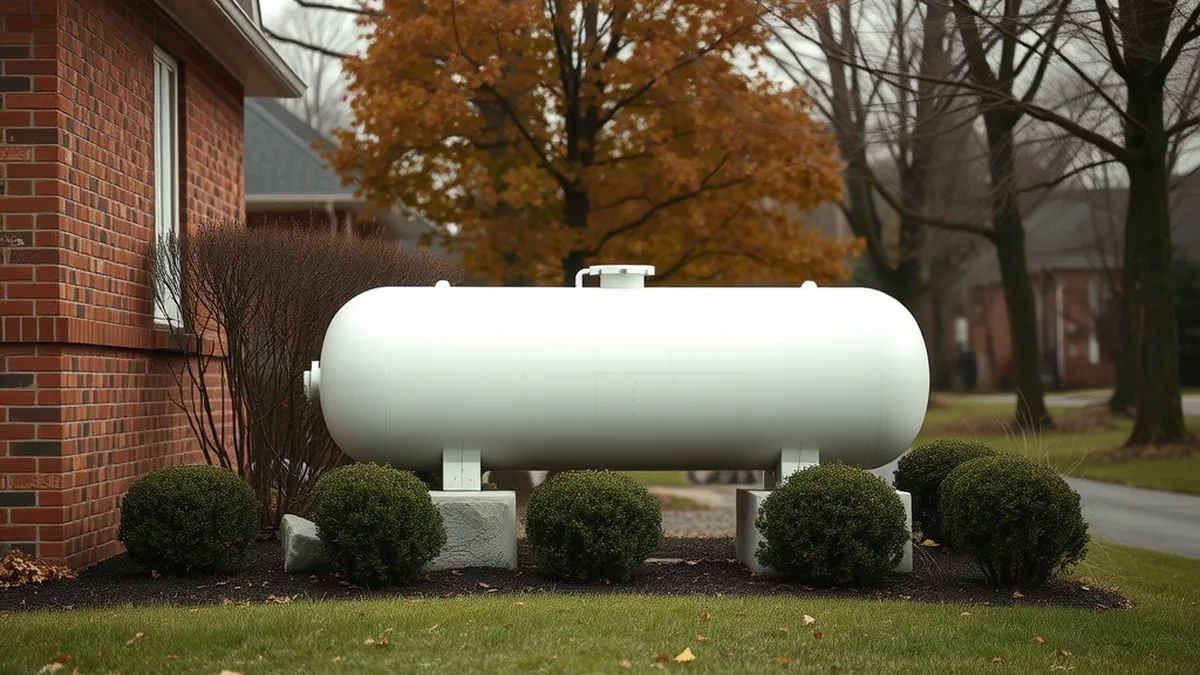
Gas mains follow the houses. In much of western Montgomery County they simply don’t reach, and those homes run on a tank in the yard.
At $3.72 a gallon — Maryland’s residential propane price at the end of the last heating season — propane costs about $54 per million BTU of delivered heat, against about $21 for natural gas. It’s still cheaper than electric resistance heat, but only by about fifteen percent, not by the wide margin the word “gas” implies.
That changes the ranking. On propane, a wood-burning insert saves you real money every winter, and the payback on converting an open fireplace comes a lot sooner. A gas fireplace is still a perfectly good choice on propane — it’s convenient, it’s clean, and running one a few evenings a week costs very little in absolute terms. Just don’t choose it expecting it to be the cheap way to heat.
Check which one you have before you shop. If there’s a tank beside the house, you’re on propane.
What happens when the power goes out?
This part decides it for some households, and it never comes up in national comparison articles.
- Wood works, period. The blower stops without power; the firebox keeps radiating.
- Gas usually works. Older millivolt units with a standing pilot need no electricity at all. Most current models use electronic ignition and carry a battery backup for exactly this — ask which system the model uses and whether the batteries are in it.
- Electric does nothing. It’s a heater that runs on the one thing you just lost.
If riding out a multi-day outage is on your list, that list has two items on it.
Do you need a permit?
Yes, for gas and for wood — and the two go to different places, which trips people up.
For gas, natural or propane, the permit and the inspection come from WSSC Water, which handles gas appliance installations in Montgomery County and requires a licensed master gasfitter to do the work. The venting and any structural work go through the county’s Department of Permitting Services. For wood, it’s DPS. A plug-in electric fireplace generally needs nothing, though a hardwired one means electrical work.
Your installer files the permits and schedules the inspections. Confirm what applies to your job with them, with WSSC, or with DPS before work starts — those agencies are the authority here, not a website, and requirements change. The full process, fees included, is in fireplace permits in Montgomery County.
To be clear about our part: we sell and advise, and we don’t install. We’re not licensed contractors. We line up an installer we’ve worked with, lock in their price before you order, and stay involved through delivery and hand-off — but that contract is between you and them, and we take nothing for it. More about how we work.
Building new in Montgomery County? Read this one first.
Montgomery County passed Bill 13-22 in 2022. It directs the County Executive to issue all-electric building standards for new construction no later than December 31, 2026 — a deadline that survived a homebuilders’ lawsuit over federal preemption in the district court in March 2026 and is under appeal, so confirm where it stands before you plan around it.
The bill lists what the standard does not apply to. Item five on that list is “gas-powered fireplaces and gas-fired outdoor grills.” They’re exempt by name.
So if you’re building in the county: your new house is heading toward heat pumps and induction, and your fireplace and your grill may still be gas. One thing the bill doesn’t settle is whether there will be gas to burn. Nobody is obliged to run a service line to an otherwise all-electric house, and in much of Upcounty that means an exempt fireplace runs on propane — which is a tank to site and a line to trench. Worth raising with your builder early rather than at rough-in.
A few other things worth knowing: the requirement is aimed at new construction, not at remodeling the house you already live in; permit applications filed before the regulation takes effect aren’t covered; and income-restricted housing, schools, and residential buildings of four or more stories have until the end of 2027.
We’re reading the bill, not giving legal advice. If this affects your project, have your architect or builder confirm the current regulation with DPS.
So which one should you pick?
Short rules, from the conversations we have most often:
- On natural gas, and you want the room warmer without thinking about it — a direct-vent gas fireplace or insert. This is the majority answer.
- You already have a masonry fireplace that does nothing — a wood or gas insert, depending on how much you enjoy fire as an activity. Either one turns dead masonry into a working appliance.
- On propane, and heat is the point — look hard at wood. The fuel math is a different shape out there.
- Power outages are on your mind — wood, or gas with a standing pilot or battery backup.
- Condo, bedroom, basement, or a rental you can’t cut into — electric. No venting, no permit, no argument with the HOA.
- You want the look above all — electric, or a gas fireplace on a low setting. Spend the savings on the surround.
We carry gas and wood equipment from Regency and Majestic, among nine brands, with more on all three technologies here. We’ll also tell you when the cheaper option is the right one — we’d rather sell you the right fireplace once.
A few more questions we get
Can I convert my wood fireplace to gas?
Usually, yes — with a gas insert or a gas log set, depending on what you want from it. It’s one of the most common projects we see.
Are ventless gas fireplaces allowed in Maryland?
Unvented room heaters are allowed under the fuel gas code enforced here, but with real limits: a maximum input of 40,000 BTU per hour, a required oxygen-depletion sensor, restrictions on bedrooms and bathrooms, and they can’t be a dwelling’s only heat source. One more thing: an unvented appliance dumps all its combustion moisture straight into your house. In a tight modern home, that shows up on the windows. We’d steer you to direct vent.
Which fireplace is cheapest to install?
Electric, by a wide margin — often just the unit and an outlet. Gas and wood both involve venting, which is where the cost lives. We broke a wood insert conversion down line by line in what a wood-burning insert costs to convert.
Does a gas fireplace need a chimney?
No. Direct-vent models vent through an exterior wall. If you have a chimney, it can often be used, but it isn’t required.
How long does any of this take?
In our experience most units arrive in under two weeks — Regency usually about one — though stock moves daily. Add permit and installer scheduling on top. Fall is peak season here, so if you want it working this winter, start early.
Not sure which one fits your house?
Send us a photo of the room and the wall you have in mind, and tell us whether you’re on natural gas or propane. We’ll tell you what will actually work there, what it costs, and what it will cost to run — before you commit to anything.
Request a quote · Serving Montgomery County, Maryland · By appointment, Mon–Fri 9–6 and weekends
