
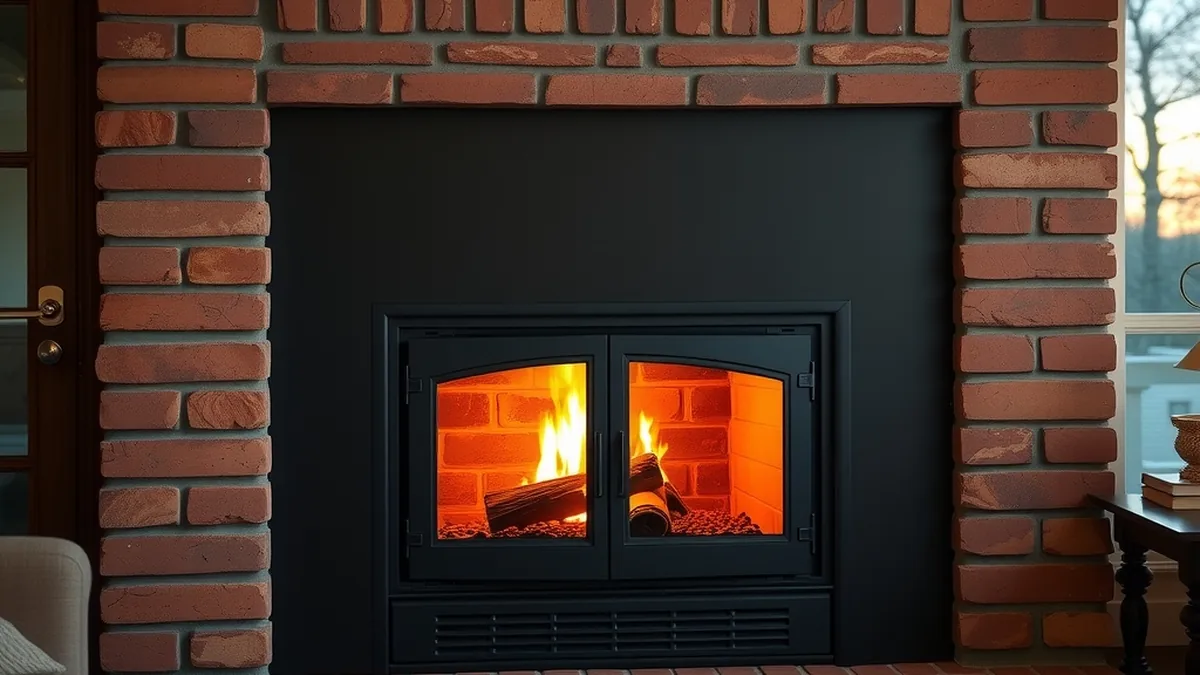
If you have a masonry fireplace that looks wonderful and heats nothing, you already know the problem. The question is what it costs to fix, and whether the fix is worth it. Here’s the honest math.
The short version: for most Montgomery County homes, converting an open fireplace to a wood-burning insert runs $5,000 to $9,000 all in — the unit, a stainless liner, labor, and a standard surround. A large cast-iron unit, a 30-foot chimney in poor shape, or custom finish work can push it past $12,000.
What an open fireplace actually does to your heat
An open masonry fireplace runs at roughly 10 to 20 percent efficiency. Most of the heat from the fire goes straight up the chimney, along with a steady column of air drawn out of the room to feed it.
That last part is the one people miss. While the fire burns, your fireplace is pulling warm air out of the house. Your furnace notices and works harder. On a cold January evening in a Potomac colonial, an open fire can leave the rest of the house cooler than it was before you lit it. Leave the damper open overnight and the chimney keeps doing its job — just without the fire.
None of that makes an open fireplace worthless. It’s lovely to sit in front of. It’s simply not a heater, and it was never engineered to be one.
What a wood-burning insert changes
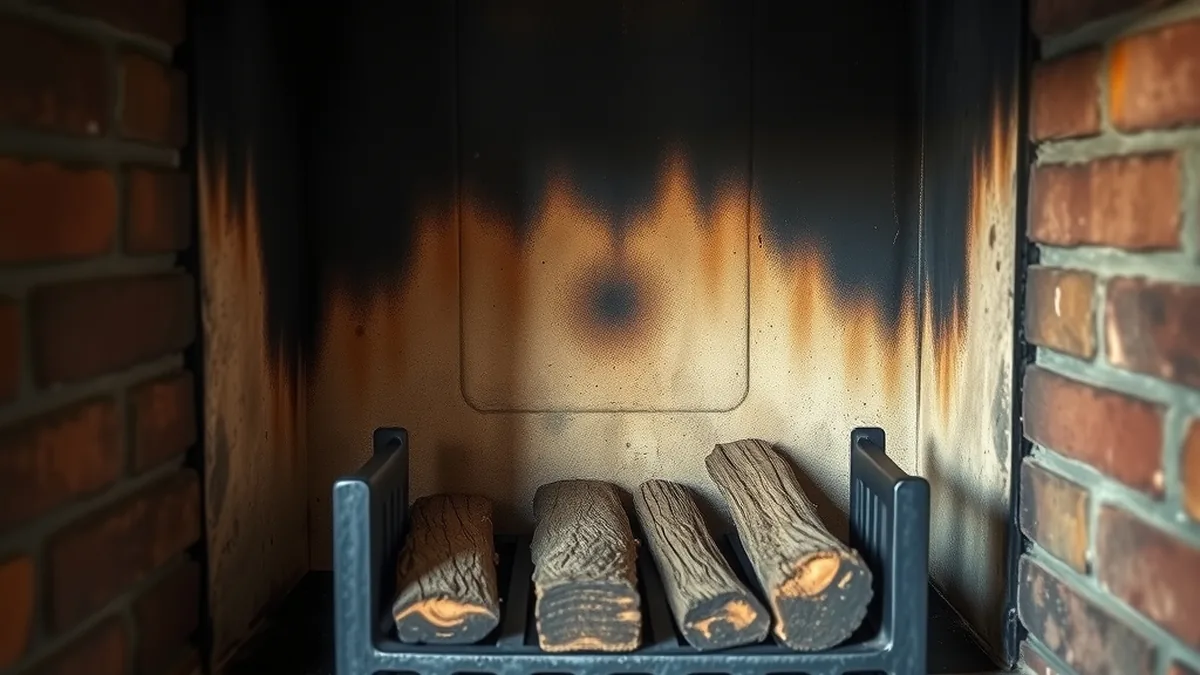
An insert is a sealed steel or cast-iron firebox that slides into the opening you already have. The fire burns behind glass, drawing its combustion air through a controlled inlet instead of pulling it out of your living room. A stainless steel liner — a flexible pipe that runs from the insert up the inside of your chimney — carries the exhaust, so the insert vents through the masonry rather than relying on it as an open shaft.
EPA-certified wood inserts run 65 to 80 percent efficient, with most current models in the low-to-mid seventies. They meet the EPA 2020 standard: no more than 2.0 grams of fine particles per hour on the crib-wood test, or 2.5 on the cordwood test. Heat output typically runs 30,000 to 80,000 BTU per hour, depending on size. That’s enough to heat the room it sits in — and in an open floor plan, a good deal more.
The practical difference: instead of losing heat while the fire burns, you gain it. A well-sized insert, loaded with seasoned hardwood, will usually hold a fire overnight and still have coals in the morning.
First, check which kind of fireplace you have
Look inside the opening. If the firebox is brick or stone all the way around, you have a masonry fireplace, and everything below applies.
If the firebox is metal, with a stamped metal label somewhere inside the opening or just above it, you have a factory-built fireplace — often called zero-clearance. Plenty of homes built around here between the mid-1980s and the mid-2000s have them. Those take a different insert, one specifically listed for that firebox model, and sometimes a full replacement instead. The numbers shift.
Send us a photo of that label and we’ll tell you which one you’re dealing with before you go any further.
How much does a wood-burning fireplace insert cost?
A note on who does what: we sell and advise — we don’t install. Of the four lines below, one is ours. The rest come from the licensed installer we bring in. We’d rather you see all four up front than get one lump sum and wonder what’s in it.
| Line item | Typical range |
|---|---|
| The insert | $1,500 – $3,500 |
| Stainless liner, installed | $1,800 – $4,000 |
| Installation labor | $500 – $1,250 |
| Surround and finishing | $300 – $2,500 |
| Typical total | $5,000 – $9,000 |
1. The insert itself
Typically $1,500 to $3,500, and higher for large units, cast-iron bodies, or premium finishes. This is the line where your choices show up: firebox size, glass area, blower, door style, and soapstone or steel. It’s also the only line that’s ours.
2. The stainless chimney liner
The liner is not optional, and it is not a small line. The kit itself runs a few hundred dollars in materials. Lining a typical chimney — materials plus the roof work — commonly comes to $1,800 to $4,000, and taller or harder-to-reach chimneys push past that.
3. Installation labor
Typically $500 to $1,250 on top of the liner work: setting the insert, making the final connection, sealing the surround, and checking the draft. That’s your installer’s number, not ours.
4. Surround and finishing
The part nobody budgets for. A surround is the flat panel that covers the gap between the insert and your existing opening. Add a hearth extension if the code calls for one, and masonry work if the opening has to be modified. A few hundred dollars for a standard panel, several thousand if you’re reworking the mantel while you’re at it.
What makes the price go up
- Chimney height and condition. A taller chimney needs more liner. A damaged flue may need repair before anything goes into it.
- Access. Steep roofs, three-story homes, and chimneys set back from the roof edge all add labor.
- Opening size. If your opening is smaller than the insert you want, masonry has to come out. If it’s much larger, you need a bigger surround panel.
- Whether the chimney has ever been lined. Older homes across Montgomery County often have unlined or clay-tile flues that need attention regardless.
This is why a real number requires seeing the fireplace. Photos and a tape measure get you most of the way there.
Do you need a permit in Montgomery County?
Yes. Installing or replacing heating equipment in Montgomery County requires a permit from the Department of Permitting Services (DPS), and the work gets inspected. Applications are filed online, and your installer normally handles both the permit and the inspection scheduling.
Maryland licenses HVACR contractors, and hearth venting work generally falls under that licensing. Ask any installer for their Maryland license number before they quote you, and ask who is pulling the permit. This is not a weekend project.
Two practical notes. Build permit and inspection time into your schedule — it’s not long, but it’s not zero. And confirm the specific permit type with your installer or with DPS directly before work starts; requirements change, and the county is the authority here, not a website. We laid out the whole process, agency by agency, in fireplace permits in Montgomery County.
One more call to make: your insurance company
Adding a wood-burning appliance can change what your policy covers, and carriers differ on what they ask for. Call your agent before the work starts, not after a claim. It’s a five-minute conversation, and it’s a good reason to have the job done properly on paper.
Is there still a tax credit for wood stoves in 2026?
No. You’ll still find pages promising a 30 percent federal credit on wood and pellet stoves — that’s Section 25C, and it ended on December 31, 2025. Maryland’s Clean Burning Wood and Pellet Stove Rebate Program closed earlier, in 2024. Neither is available now.
One exception: if your stove was installed on or before December 31, 2025, you can still claim the credit on that year’s return. For anything installed since, there’s no federal credit.
We mention it because that promise is still all over the internet, and it’s a rotten thing to discover after you’ve signed a quote. Budget for the real number.
What it costs to run
Firewood, and one annual chimney cleaning and inspection — usually $150 to $300 around here. A cord of seasoned hardwood in Montgomery County runs a few hundred dollars, and how many you burn depends entirely on how you use the fireplace. Gaskets and glass are the only parts that wear, and not often.
Is a wood-burning insert worth it?
If you want the fireplace to heat, an insert is usually the least expensive way to turn an open firebox into real heat output. You’re reusing the masonry, the chimney, and the opening.
If you mostly want the look and light a fire six times a winter, the math is different, and a gas insert or a set of gas logs may serve you better for less trouble. We’ll tell you that too — here’s how gas, wood and electric compare, and the gas options on our Fireplaces page.
Where an insert consistently pays off: homes where the fireplace sits in the main living space, households that genuinely enjoy burning wood, and anyone who lost power for three days the last time a Maryland ice storm came through and would like the living room to stay warm next time. Worth knowing: the blower needs electricity, but the insert keeps radiating heat without it.
A few more questions we get
How long does the installation take?
A straightforward install is a one-day job once the permit is in hand. Getting the permit and scheduling the inspection is what sets the calendar.
Can I use my existing chimney?
Almost always, yes — that’s the point of an insert. It needs to be sound enough to take a liner, which the installer checks before quoting.
Will it work during a power outage?
Yes. The blower stops without power, but the firebox keeps radiating heat into the room.
How often does it need cleaning?
Once a year for a regularly used insert, more if you burn a lot of softwood or unseasoned wood.
How to get a real number
Send us three things and we can usually narrow it down quickly:
- A photo of the fireplace, straight on, with something for scale
- The opening measurements — width, height, and depth
- A photo of the chimney from outside, if you can get one safely
We’ll match the unit to your opening and explain the trade-offs between models. We carry wood inserts from Regency and Majestic, and we can source most major brands on request.
Then we coordinate with a licensed installer who does this work every day. You’ll get one written quote from us for the equipment and a separate one from the installer, so you can see exactly what each part costs instead of one lump sum — and both get approved by you before anything is ordered. More about how we work.
Ready for a real number on your fireplace?
Send us a photo of the opening and the measurements. We will tell you which inserts fit, what they cost, and what the installation is likely to run — before you commit to anything.
Request a quote · Serving Montgomery County, Maryland · By appointment, Mon–Fri 9–6 and weekends
